Production information
Production dates: September 1946 – March 27, 1950
Crew
Producer: Harry Benet (Teneb Productions)
Presenter: Jack Hylton (1949-1950)
Direction: Freddie Carpenter (1949-1950)
Production manager: Patrick Vyvyan
Stage production: H. Flockton Forster
Stage director: Fred Walker
Press representative: George Fearon, Rose Heppner
Publicity: Alex Keith
Stage Manager: George Sola
Assistant stage manager: Fred Dent
Additional dialogue: Peter Cook
Set design: Jack Leonard (1946-1950)
Costumes: Flora Kandy & Morris Angel (1946)
Dancer’s costumes designs: Edgar Ritchard (1949-1950)
Dancer’s costumes: Phyllis Gainsley (1949-1950)
Prince’s costumes designs: Berkeley Sutcliffe (1949-1950)
Prince’s costumes: Morris Angel (1949-1950)
Ladies Court costumes designs: Hugh Owen (1949), Edgar Ritchard (1949-11950)
Ladies Court costumes: Helen Quinlisk
Men’s Court costumes designs: Edgar Ritchard
Men’s Court costumes: Lydia Crisp
Storyteller’s costume: Alec Shanks (1949-1950)
Shoes: Anello & Davide, Porselli
Masks: Hugh Skillen
Ballets and dances arrangements: Izna Roselli (1946-1948), George Carden (1949-1950)
Original Score composers: Frank Churchill, Larry Morey
Additional music: Cyril Dawson, George Weedon, George Saker
Conductor: Cyril Dawson (1946), George Saker (1949), Arthur Anton (1949), Paul E. Gomez (1950)
Leader & sub-conductor: Jules Guitton (1946), Edward Carwardine (1949)
Harpist: Evelyn Hall (1946), Dorothy Pullen (1949)
Drummer: Leslie Barker (1949)
Chief electrician: Alex Hewitt, Arthur Hewitt
Master carpenter: Frank Kidger (1946-1948), Ernest Catford (1949)
Assistant carpenter: Bob Taylor (1946-1948), J. Loughran (1949)
Property master: I. Ingram
Groom: James Wilde
Wardrobe mistresses: Eleanor Sola (1946-1950), Rubina Trend (1946-1948), M. Loughran (1949)
Business manager: Stanley Haysman
Secretary: Ena Roscoe
Cast
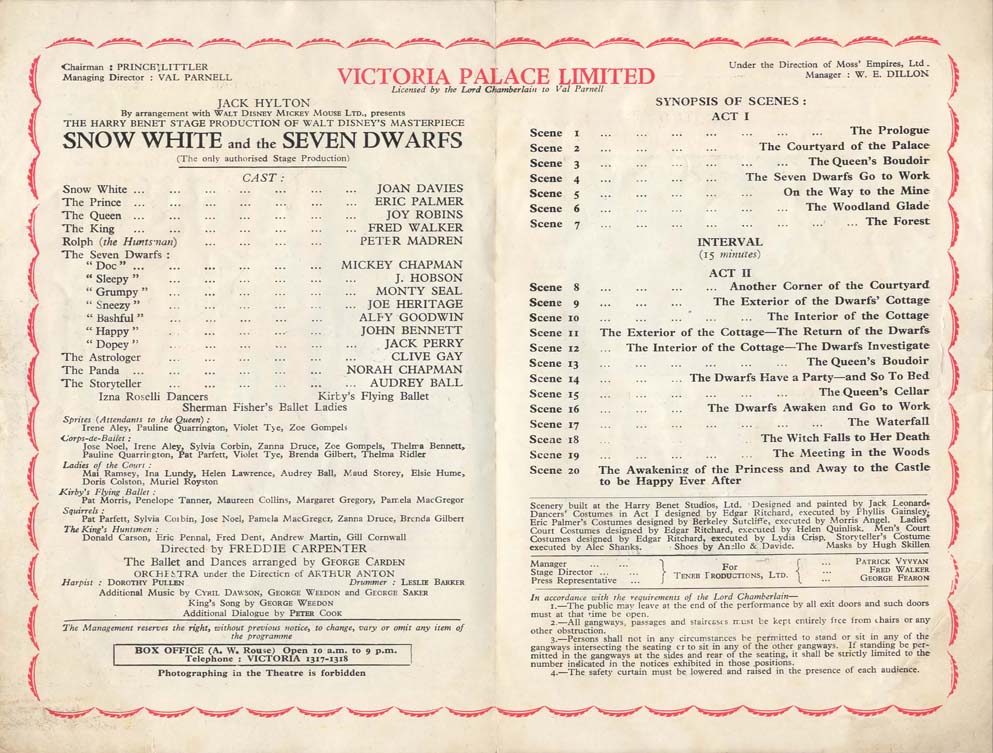
Snow White: Betty Shaw (1946-1947), Olga Fleming (1947-1948), Joan Davies (1949-1950)
Prince Charming: Bruce Carfax (1946-1947), Victor Standing (1947-1948), Eric Palmer (1949-1950)
Queen: Joy Robins (1946-1950), Hilda Campbell-Russell (1948)
King: Fred Walker
The Astrologer: George Lowdell (1946), Reginald Vincent (1947), Clive Gay (1947-1950)
The Panda: Norah Chapman
The Storyteller: Audrey Ball
Rolph the Huntsman: Charles Stirling (1946-1948), Lionel Gadsden (1947), Frank Fallon (1950)
Doc: Mickey Chapman
Happy: Jack Perry (1946-1947), John Bennett (1949-1950)
Grumpy: Monty Seal
Sneezy: Joe Heritage
Bashful: Alfy Goodwin
Sleepy: J. Hobson
Dopey: John Bennett (1946-1947), Jack Perry (1949-1950)
Joseph Kirby’s Flying Ballet: Iris Bulgin, Angela Underwood, Jeanne Weatherstone, Carole Anne David (1946), Pat Morris, Penelope Tanner, Maureen Collins, Margaret Gregory, Pamela MacGregor (1949)
Sherman Fisher’s Ballet Ladies: Iris Bulgin, Pat Parfett, Angela Underwood, Jeanne Weatherstone, Carole Anne David, Nancy Fenton, Jackie Powell, Enid Cockrill, Pauline Quarrington, Nancy Woodall, Sheila Wright, Ann Hunter, Marjorie Shewring (Shewling?), Barbara Croad, Naomi Dunning, Ann Edgington (1946), June West, Helen McNair, May Stephan, Ann Strickland (1947), Jose Noel Irene Aley, Sylvia Corbin, Zanna Druce, Zoe Gompels, Thelma Bennett, Pat Parfett, Brenda Gilbert, Thelma Ridler
Izna Roselli Dancers: Hazel Bayless, Daphne Freeman, Oreen Shann, Paddy Johnson, Katharine Ling, June Price, Greta Hunstead, Pat Kaufman, Violet Stoneham
Ladies of the Court: Eve Clair, Eileen Perry, Jean Hyde, Carol Nash, Ann Desmond, Leila Perry, Marie Livann, Denise Pitt-Draffen (1946), Gem Allison, Mai Ramsey, Patricia Clarke, Lucille Dale, Marwenna Buscarlet, Vicki Gail, Eve Aubrey, Freida Kennedy, Norma Griffin, Betty Farley, Sadie Glen, Pearl Lundy (1947), Ina Lundy, Helen Lawrence, Audrey Ball, Maud Storey, Elsia Hume, Doris Colston, Muriel Royston
The King’s Huntsmen: Harold Hesman, Charles Travers, Leonard Trend, Andrew B. Martin, Ian Stuart (1946), Fred Dent, Tony Williams, John Doye, Noel Hardwick (1947), Donald Carson, Eric Pennal, Gill Cornwall (1949)
Sprites (Attendants to the Queen): Irene Aley, Pauline Quarrington, Violet Tye, Zoe Gompels
Squirrels: Pat Parfett, Sylvia Corbin, Jose Noel, Pamela MacGregor, Zanna Druce, Brenda Gilbert
Back to Disney references
A post-war British stage adaptation
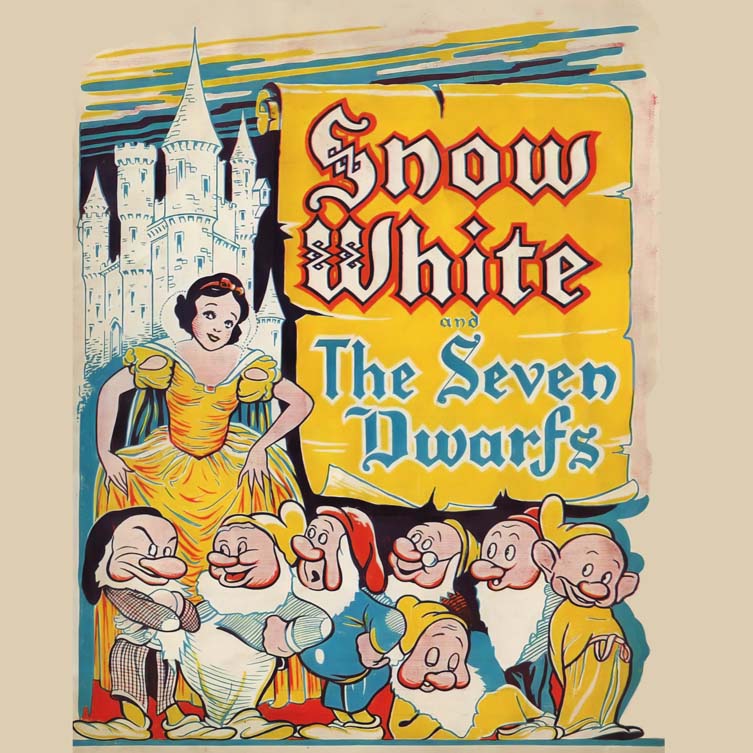
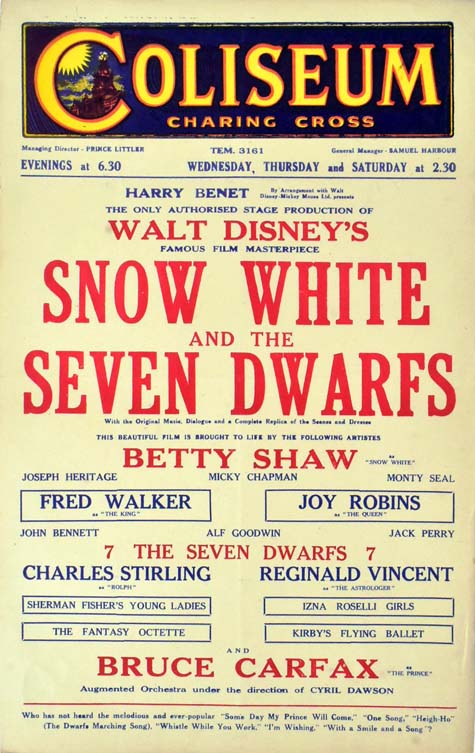
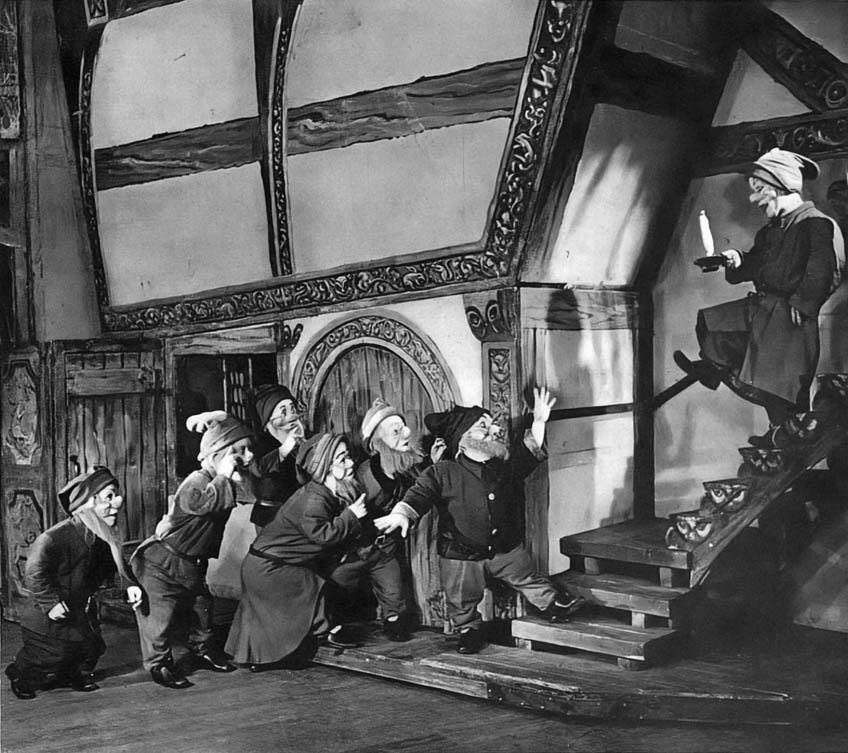
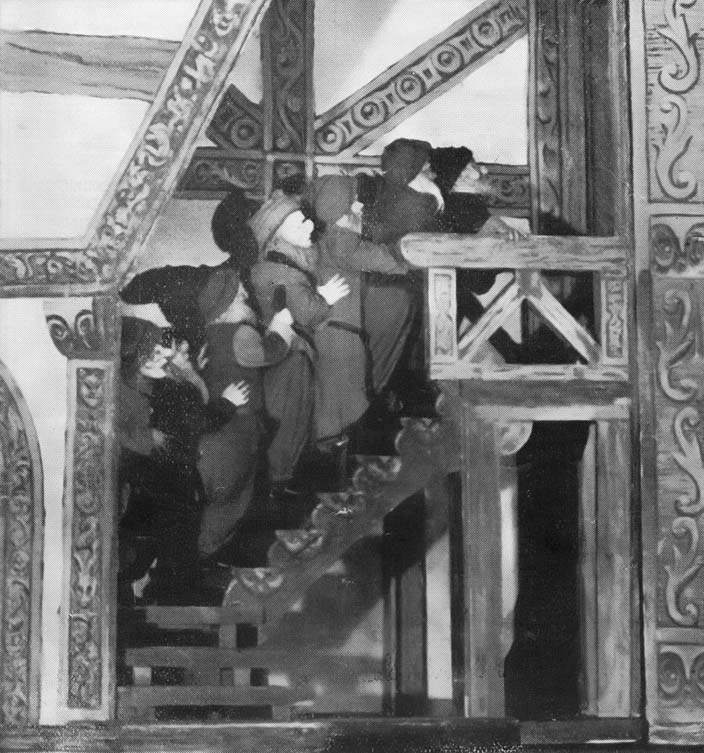
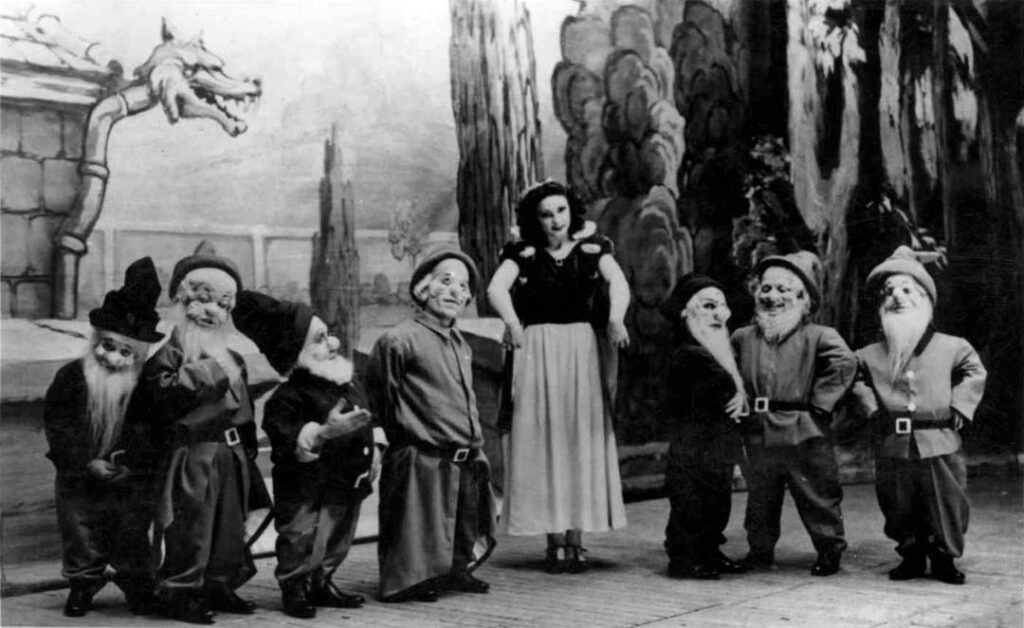
In the immediate aftermath of World War II, Snow White and the Seven Dwarfs found a new life on the British stage through a large-scale touring production presented by Harry Benet.
Officially billed as “The only authorised Stage Production”, the show was mounted under license from Walt Disney through Mickey Mouse Ltd., reflecting the growing international control Disney exercised over adaptations of its first feature film.
Blending elements of musical theatre and variety entertainment, the production drew heavily on the conventions of British pantomime—a uniquely British theatrical tradition combining fairy-tale storytelling, comedy, audience interaction, and musical spectacle— and offered audiences a richly staged interpretation of the story, complete with ballet sequences, chorus numbers, and specialty acts.
Production format and staging
Unlike a straightforward theatrical adaptation, the show followed the conventions of British popular entertainment of the time:
- A two-act structure with interval.
- A mix of scripted scenes, dance numbers.
Expanded roles including an astrologer, a storyteller, ensemble dancers and “sprites”.
The inclusion of full ballet ensembles and variety-style performers reflects the influence of the British variety theatre circuit, still dominant in the late 1940s.
The film’s original songs were retained, although the Prince was given an additional number, “As Long as I Live,” published by B. Feldman & Co., and the King also had a song composed for the production by George Weedon.
The cast
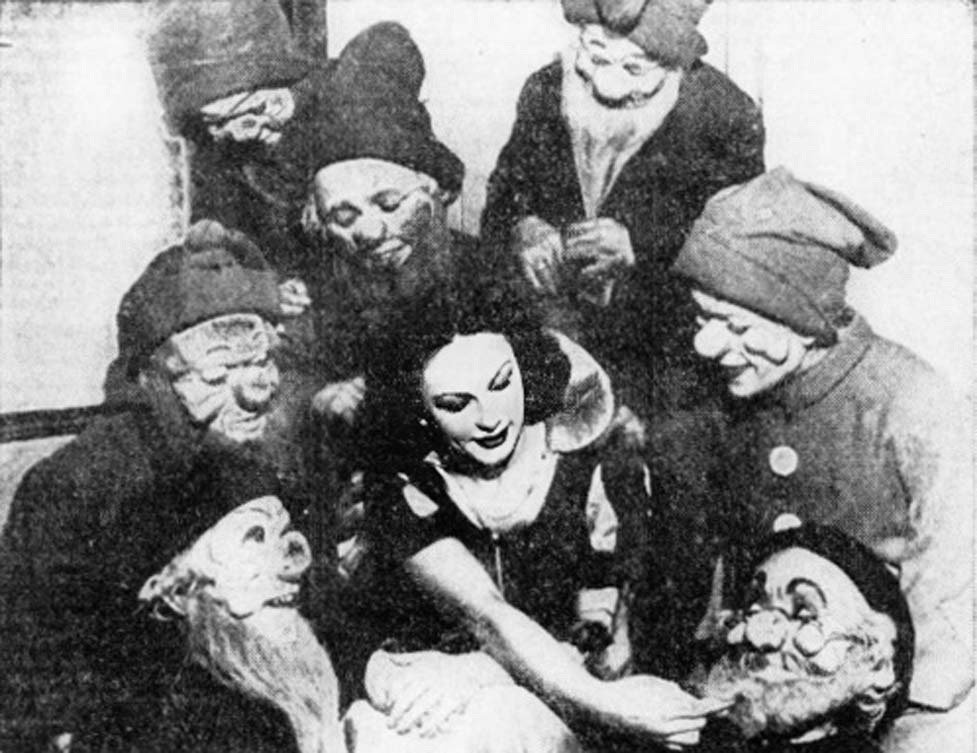
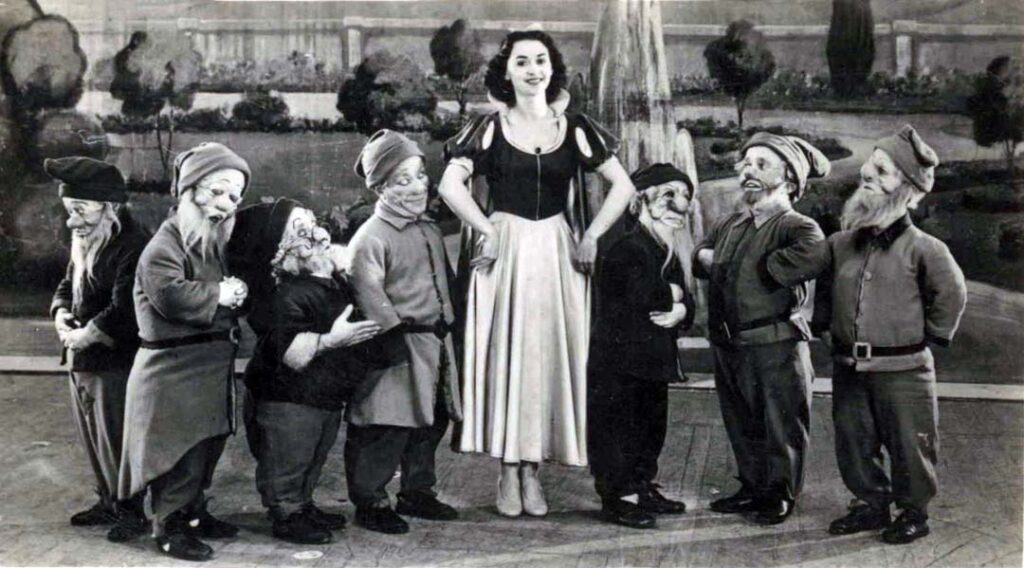
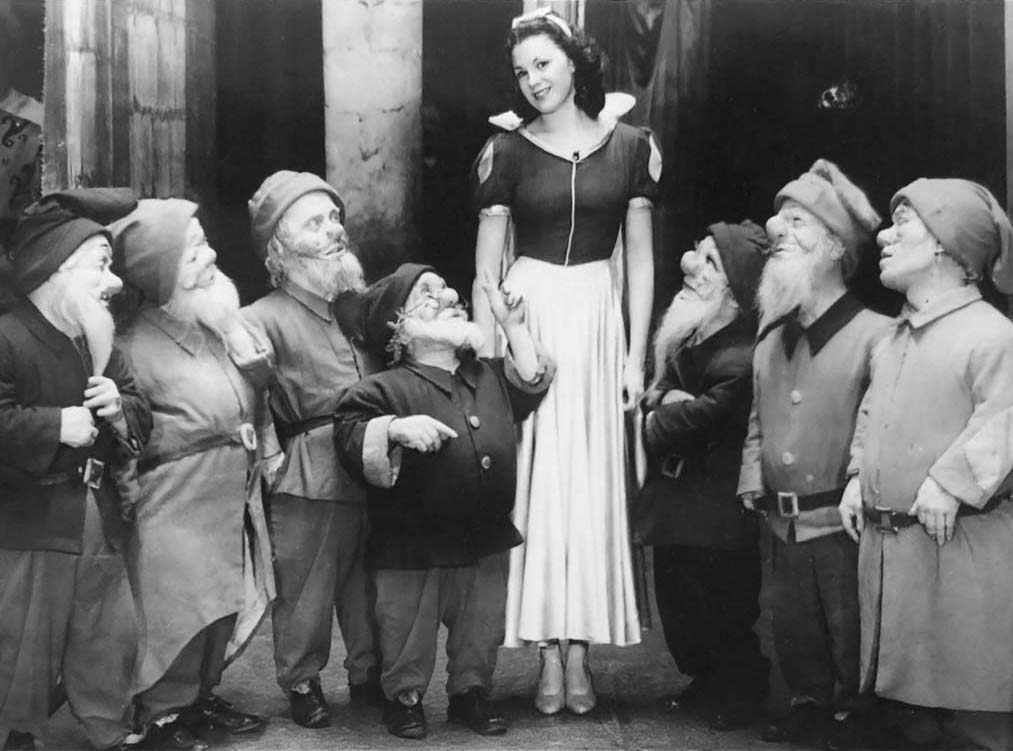
Three actresses appear to have played Snow White over the course of the production. It opened with Betty Shaw, then 19 and fresh from the play Sweeter and Lower, opposite Bruce Carfax as Prince Charming. In 1947, they were replaced by Olga Fleming and Victor Standing, who toured with the production until 1948. For the 1949–1950 tour, the roles were taken over by Joan Davies and Eric Palmer.
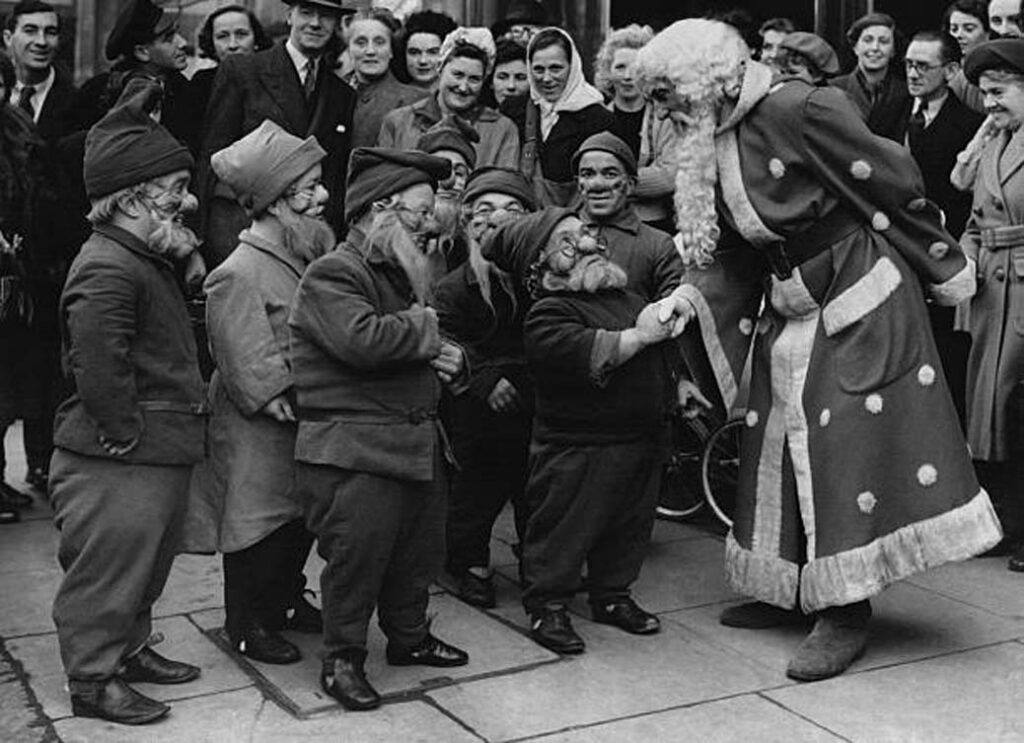
Other parts changed over time, but some performers—particularly those playing the all-important dwarfs—remained with the production throughout its run. Jack Perry and John Bennett, for instance, are known to have swapped the roles of Happy and Dopey around 1947. The Seven Dwarfs were portrayed by actors with dwarfism, a casting choice that reportedly proved challenging to maintain over an extended tour.
Reception
The production opened in September at the Wimbledon Theatre before touring the country until 1950.
The March 1, 1947 critic from Theater World by F.J.D. reads: “Was it ill-luck or ill-judgment that brought this stage adaptation to the vastness of London’s Coliseum in February blizzard which had most effectively nipped any lingering Christmas spirit? Certainly the dwarfs are chubby and charming, there is a ballet to help out, Bruce Carfax is a Prince in good voice, and Betty Shaw a beautiful and quite accomplished Snow White. But it asks too much of a young girl to fil a large stage with entertainment acceptable to an adult West End audience when dialogue and speech are trite and artificial. Long and dull patches emphasised that in such stories the screen has infinite advantages over the stage; the camera can capture forest scene and elf and animal in a manner deniedto scene shifter and ballet dancer. This is not to decry Nora Champan’s Panda, a creature of personnality.”
The three year run, however proves that the audience liked the play.
The program
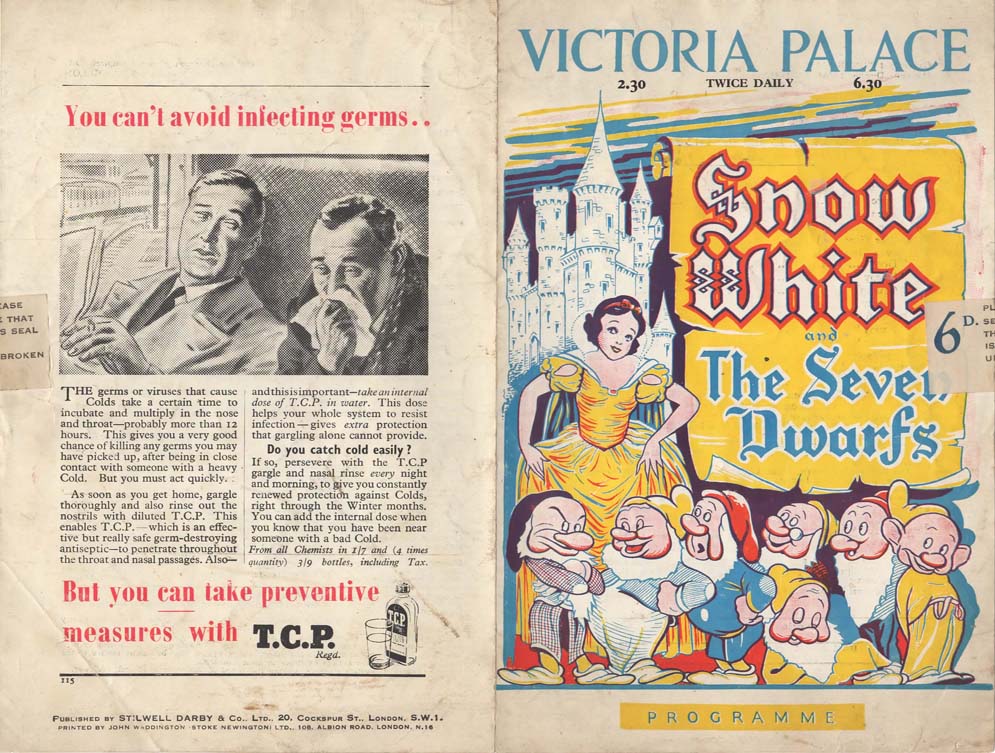
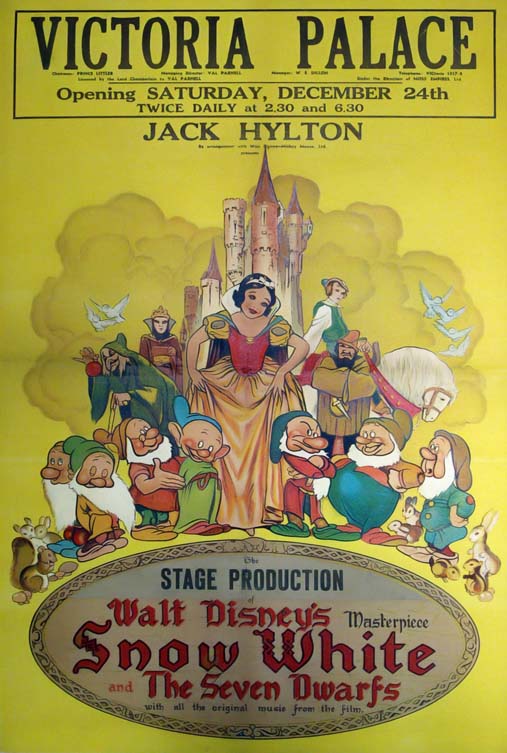
This program, sold for six pence, was issued for the Victoria Palace engagement beginning December 24, 1949.