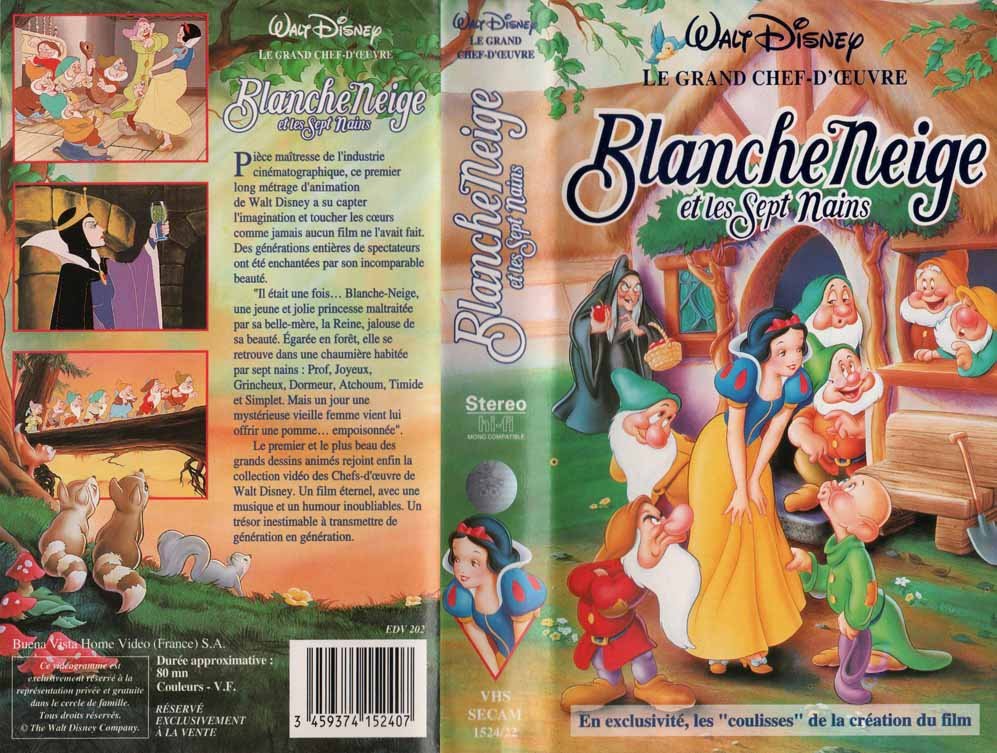
Production information
Distributed by Buena Vista Home Entertainment (France) S.A.
Production number: 22/1524
Release date: August 23, 1994
Running Time: 80 minutes (film), 9 minutes 20 seconds (documentary)
Sound: Hi-Fi Stereo Dolby Surround™
Digitally mastered
Walt Disney – The Masterpiece
Bar code: 3 459374 152407 (Retail) 3 459374 152421 (Rental)
Retail price: FF160
Back to Home Video

The First French VHS Release
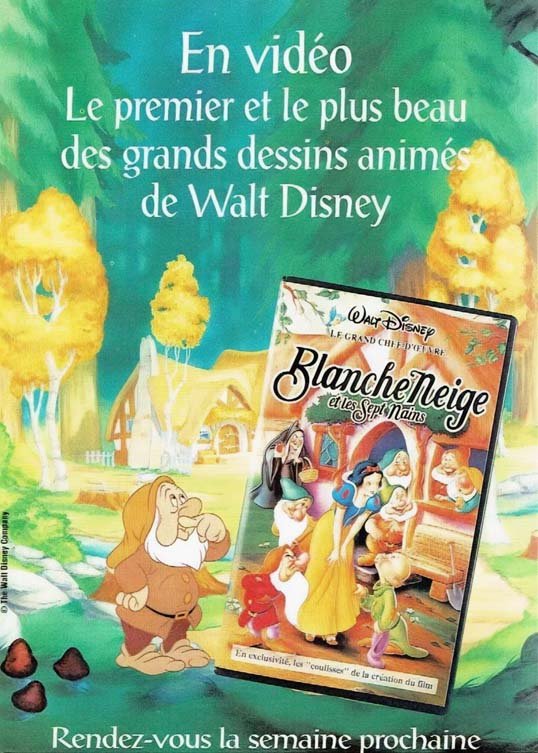
Hailed on the television news as a “world premiere,” the release of Snow White and the Seven Dwarfs on home video in France was an unprecedented commercial event. No fewer than three million VHS tapes were put on the market, supported by a massive advertising campaign and a wide range of tie-in merchandise.
In fact, although the French release did precede its American counterpart, it appears to have followed the Italian release by a short margin. Nevertheless, this does little to diminish the significance of the event, which proved to be an enormous commercial success.
The VHS featured a restored version of the film, with stereophonic sound and a picture encoded in the French SECAM color standard. As with other European video releases of the period, the transfer at 25 frames per second slightly accelerated the film compared with its original theatrical speed of 24 frames per second, reducing its running time to approximately 80 minutes.
The soundtrack featured the second French dubbing, recorded in 1962. Most of the French-language text inserts were retained, although one alteration was made to the opening page of the storybook: the original wording, “Il y avait une fois,” was replaced with “Il était une fois,” both variations of the traditional “Once upon a time.”
Rather unusually for a Disney VHS release of the period, the feature was not preceded by any advertisements. Instead, a brief announcement narrated by Benoît Allemane invited viewers to discover the secrets behind the film’s creation after the main feature.
The film was indeed followed by a nine-minute-and-twenty-second documentary narrated by Yves-Marie Maurin. Among its highlights was the famous deleted soup sequence, which French television audiences had already been introduced to in 1962, when Pierre Tchernia presented it on his television program L’Ami public numéro un.
The VHS was also available for rental, packaged in a clamshell case, unlike the retail edition, which came in a rigid side-opening case. The rental edition’s cover artwork also differed slightly, with the title printed entirely in white, without the blue highlights found on the retail version.
A diamond-shaped sticker affixed to the cassette’s shrink-wrap advertised a promotional contest offering the chance to win diamonds. It read: “Win diamonds or request a game card from ‘Carte magique/SFDD – 78613 Le Perray Cedex’ (postage reimbursed at the economy rate upon request). Offer valid until June 30, 1995. Look inside now!”
Sales of the VHS were discontinued in February 1994. This limited availability, announced from the outset, was part of a marketing strategy designed to create a sense of urgency among consumers and encourage purchases before the title was withdrawn from the market.
VHS Cover