Information
Type of toy: rubber figurines
Country of manufacture: France
Country of distribution: France
Date: May 1938 – 1963
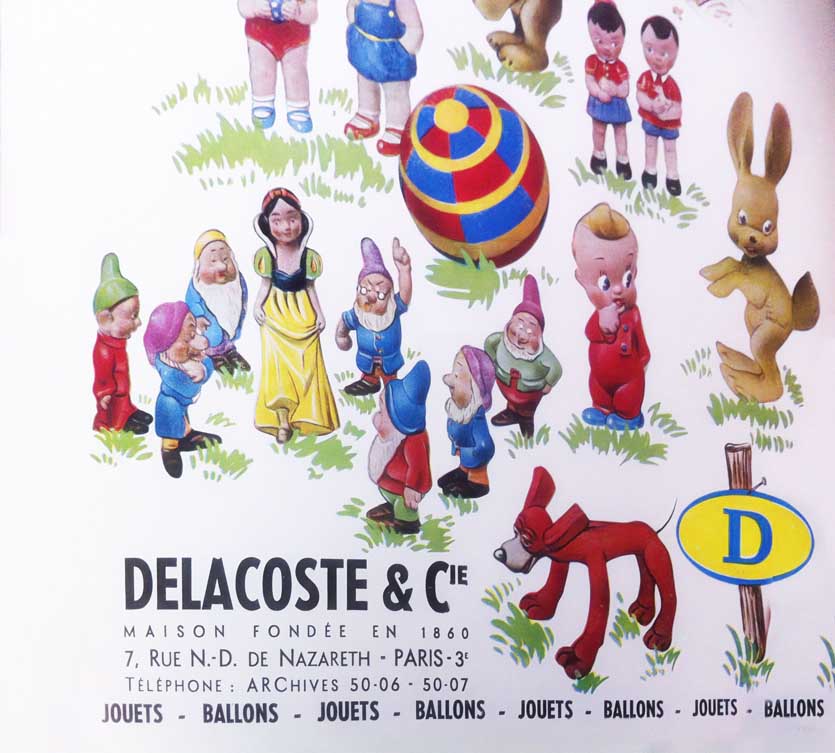
Manufacturer: Delacoste et Cie., 7 rue de Notre-Dame-de-Nazareth , Paris IIIe
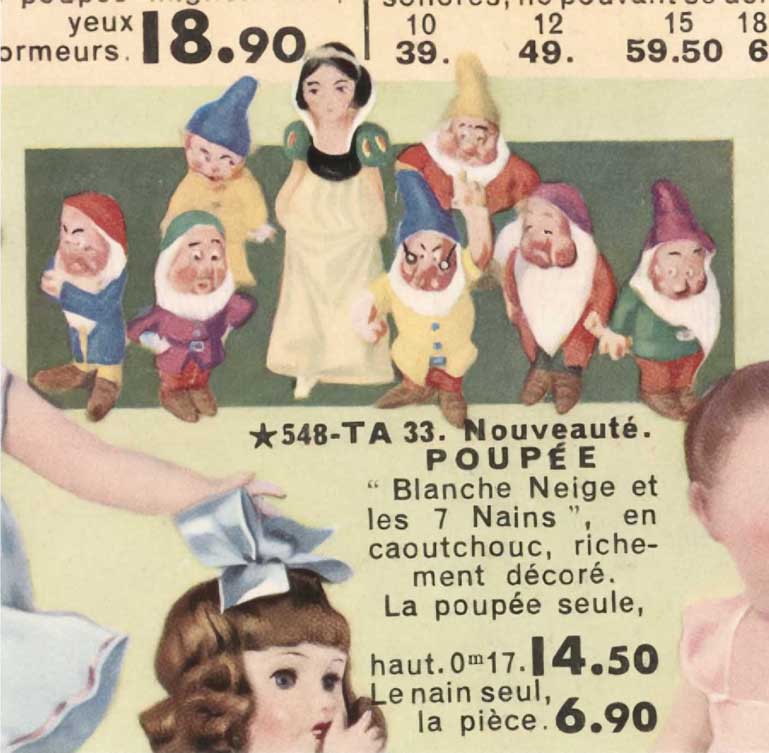
Retail price: FF14.50 for Snow White, FF6.90 for each dwarf
Dimensions: 6.7” for Snow White, 5.12” for each dwarf
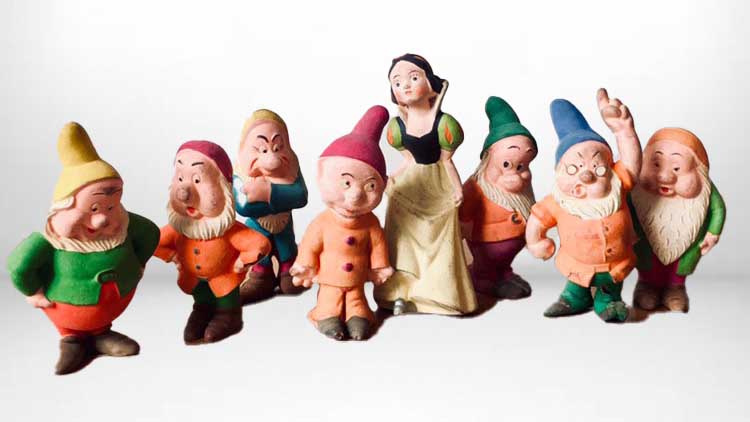
The French Seiberling toys
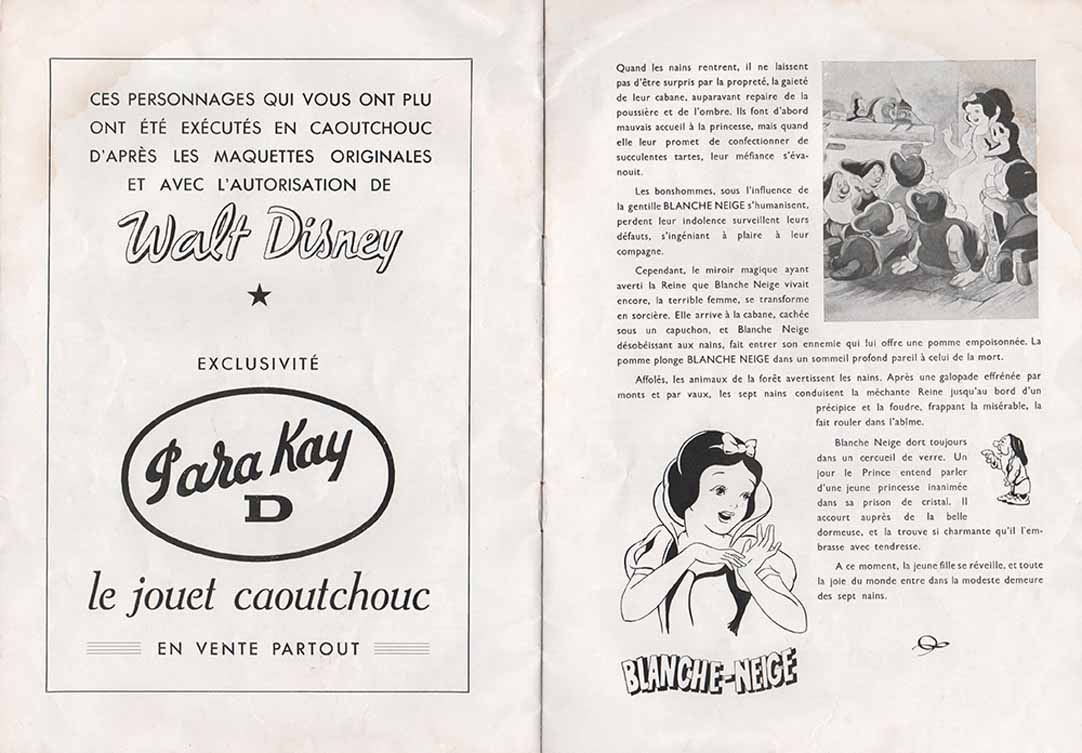
The 12th page of the Marignan Theater program for Snow White and the Seven Dwarfs advertises “Para Kay D” rubber figurines, “The characters you loved were made in rubber from the original cast with the authorization of Walt Disney.”
A drawing of these rubber figurines appears in the 1938 Christmas catalog of the famous Galeries Lafayette department store. They are sold under the catalog number 548 TA 33 for FF6.90 per dwarf and FF14.50 for each 6.7″ Snow White doll.
On the back of each character is a whistle that emits a sound when the rubber of the figurine is squeezed.
They were manufactured by Delacoste and Company who had owned the Walt Disney licence since 1935. The original company was founded in 1862 by Mr. Culaz, and then taken over by B. Derolland in 1972. The D. present on the toys apparently stood for Derolland until 1912 when his nephew, Delacoste took over. In 1961, the invented the famous baby toy Sophie the giraffe. The company was later bought by Vullierme in 1982, which in turn became Vulli in 1989.
interestingly, An invoice from 1906 mentions Ledra Brothers. Ledra manufactured Disney rubber toys in Italy.
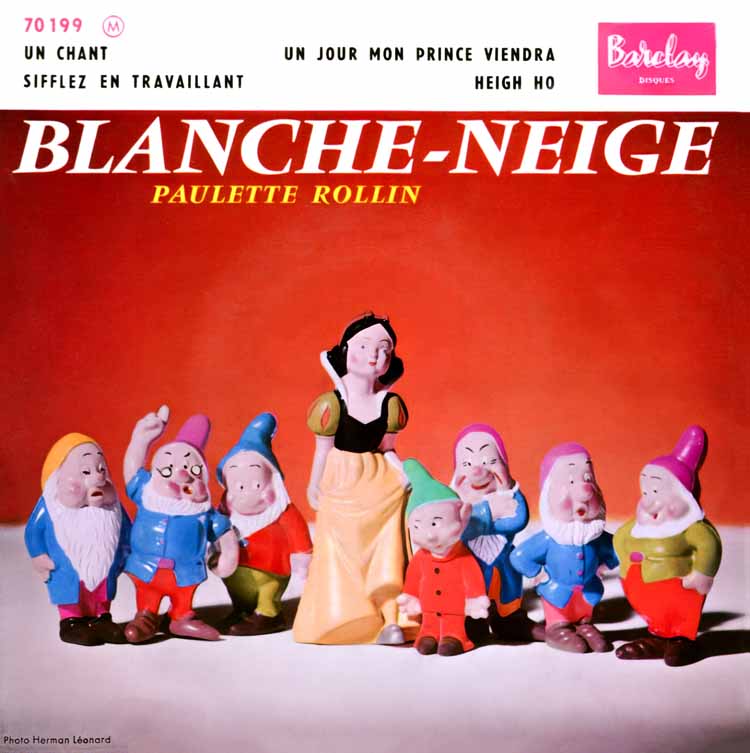
If the dwarfs are faithful to the American Seiberling models, Snow White has been completely redesigned. Various versions of these figurines were sold through the years until at least 1963. In 1955, the set appeared in Toys trade catalogs. And in 1958, the set appears on the cover of the Snow White record by Paulette Rollin.
Delacoste later made different sets of Snow White and the Seven Dwarfs figurines.
The newspaper La Cheminée, a monthly publication for employees of the Delacoste factories, was launched in 1937. As early as the April issue, an article by Ch. Chauvin entitled “Snow White and the Seven Dwarfs” opens as follows:
“Soon, the Delacoste factories will be releasing from their workshops new little figures which, at first glance, have a rather grotesque appearance. They are characters with venerable beards, enigmatic looks, and dressed in carnival attire. (…) They are the latest offspring of Walt Disney.”
In the January 1939 issue, an article by Chauvin and Rouland entitled “The Triumph of Christmas” describes their journey through the major department stores of Paris during the Christmas season.
At Galeries Lafayette, they come across a Para-Kay toy stand: “The counter is slightly crescent-shaped, with shelves on which the finest pieces of our manufacture are offered for the customers’ selection and pleasure, skillfully presented in boxes or wrapped in cellophane.”
At the Printemps department store, they describe a fairy-tale installation: “At the back, behind the three rotundas, a charming display window brings to life the Queen’s court and the stars of the day: Snow White and the Seven Dwarfs. The scene, admirably rendered, represents a cut-out from the film at the moment when Disney’s characters perform the wild vision of the ball. The figures are electrically animated, making this display a faithful and lively reproduction of the film for those who have seen it projected. A loudspeaker continuously plays the lyrical songs from this production.”
On the fifth floor, they find “the Delacoste company counter,” made of “cut wooden paneling, neatly assembled into arched, circular shelving, all painted yellow with green trim.”
At La Samaritaine, a display window permanently showcases Delacoste products on three shelves, the lowest of which is “exclusively filled with the various Walt Disney figures—Mickey, The Three Little Pigs, Snow White, etc.”
Another window, specially stocked for Christmas, presents “the same subject as at Galeries Lafayette: Snow White, but this time better displayed and more complete.”
Naturally, this same issue also includes an article entitled “Snow White and the Seven Dwarfs” on page 5, intended to introduce the animated film to factory employees and explain how it was made. The article nevertheless reveals that the factory is operating at full capacity thanks to these figurines: “Despite all our efforts, we are unable to meet the numerous demands from our customers.”