Information
Complete title: Walt Disney’s classic Snow White and the Seven Dwarfs
Authors: Michelle Sewell, Darryl Finer, Kate Lee & Mazen Freige
Publication Date: 1994
Country: Great Britain
Dimensions: 8.27” x 11.69” (A4)
Number of pages: 20
Back to Campaign and Press books
This press kit, published for the 1994 British re-release of Snow White and the Seven Dwarfs, brings together general information about the film, its history, and its production, along with an extensive section devoted to its digital restoration. It covers the origins of the project, recollections by Walt Disney and several studio artists, the creation of the characters and the personalities of the Seven Dwarfs, the casting of Adriana Caselotti, the music, deleted scenes, the 1937 premiere, and the film’s reception. The document also provides numerous production statistics and details the work carried out by Disney, Kodak, and Cinesite to restore the picture and sound for the 1993–1994 re-release.
The oft-repeated story that the Ink and Paint Department applied actual makeup directly to Snow White’s cels—here attributed to Frank Thomas—is once again repeated in this document, despite having since been debunked.
The press kit also states that the film’s songs had been translated into 13 languages besides English. This figure is puzzling: it does not correspond to the original release, for which only ten foreign-language versions were produced, while by 1994 the film was available in roughly twenty foreign languages.
Curiously, the material appears to have been prepared in 1993, even though the press kit clearly identifies the film’s British re-release dates as July 1 and July 22, 1994. It seems likely that the content was simply reproduced from the North American press materials, since the text refers twice to a “1993 re-release.” The date at the end of the document, “6/1/93,” therefore probably means June 1, 1993, shortly before the film’s July 1993 re-release in the United States.
Walt Disney Pictures Presents
Walt Disney’s Classic Snow White and the Seven Dwarfs
Adapted From
Grimm’s Fairytales
Supervising Director:
David Hand
Supervising Animators:
Hamilton Luske
Vladimir Tytla
Fred Moore
Norman Ferguson
Voices Include:
Adriana Caselotti
Harry Stockwell
Lucille Laverne
Moroni Olsen
Billy Gilbert
Pinto Colvig
Otis Harlan
Scotty Mattraw
Roy Atwell
Certificate: U
Running Time: 84 Mins
U.K. Release Date:
Scotland – July 1st 1994
Nationwide – July 22nd 1994
A Buena Vista International (U.K.) Ltd release
Publicity:
BVI Press Office: (071) 605 2877 / 2828 / 2976
Michelle Sewell/Darryl Finer/Kate Lee/Mazen Freige
“Snow White and the Seven Dwarfs”
Production Information
Magic Mirror on the Wall
Who is the Fairest one of all?
It doesn’t take a magic mirror to know that the first and “fairest” of Disney’s classic animated features was the 1937 masterpiece “Snow White and the Seven Dwarfs.” From its “once upon a time” beginning straight through to its “happily ever after” ending, this beloved Disney fairy tale has been enchanting audiences all over the world for nearly six decades and has set the standards of excellence and entertainment by which Disney animated features continue to be measured.
The film last appeared in theaters on the occasion of its 50th anniversary (in 1987), at which time it set new domestic and international box office records for a Disney animated release.
With this latest reissue, “Snow White” returns exclusively to theaters and adds yet another first to its already impressive list of achievements by becoming the first motion picture to make use of a new breakthrough state-of-the-art digital restoration process. This means that the film will look better than ever before and even slight imperfections that existed on the film’s original negative have been repaired or removed for the 1993 reissue. Additionally, the original soundtrack for “Snow White” has been remixed and upgraded to approximate Dolby Stereo and maximize the film’s sound quality for today’s discriminating moviegoers.
With its timeless themes, heartfelt performances, bountiful sight gags, memorable music and brilliant artistry, “Snow White and the Seven Dwarfs” is generally acknowledged to be the most popular and widely-seen motion picture ever produced by Hollywood. Rich in detail and imagination, this film stands apart from all other animated features because it was Hollywood’s first attempt at the genre and proved to numerous skeptics of the day that feature-length animation was a viable and exciting form of filmmaking. More recently, in 1989, the Library of Congress added to “Snow White’s” special place in film history by including it among the first 25 feature films to be honored and preserved in the National Film Registry.
The legacy of this landmark film dates back to 1937. Depression era audiences felt a deep emotional attachment to Snow White and embraced the antics of her seven charismatic companions. For the first time, two-dimensional cartoon characters seemed real and alive with personality. Viewers were horrified by the Queen-turned-Witch and uplifted by the film’s romantic storybook ending. They came away singing and humming such infectious tunes as “Whistle While You Work,” “Heigh-Ho” and “Some Day My Prince Will Come.” Fifty-six years later, the storytelling magic of Walt Disney and his animators continues to be just as potent, enthralling young and old alike.
Grimm’s classic fairy tale provided the starting point for the fertile imagination of Disney and his team. A silent movie version starring Marguerite Clark and a popular stage play further inspired the impressionable animation producer and convinced him that this story would be perfect for his first feature outing. Seven distinctly delightful personalities were created for the Dwarfs and a talented teenager named Adriana Caselotti was called upon to sing and speak for the beautiful Princess. Other voices in the film were provided by the late Harry Stockwell (father of actors Dean and Guy Stockwell) as the Prince, Lucille LaVerne (“Orphans of the Storm,” “A Tale of Two Cities”) as the Queen/Witch, Moroni Olsen as the Queen’s Magic Mirror, Pinto Colvig (the original voice of “Goofy”) as Sleepy and Grumpy, Otis Harlan as Happy, Scotty Mattraw as Bashful and Roy Atwell as Doc. Veteran comedian Billy Gilbert, Hollywood’s most famous sneezer, responded to an ad in Variety seeking the “voice” of Sneezy and was hired on the spot.
The story of how “Snow White” came to be made is one of the most fascinating in the annals of filmmaking. Hollywood expected the film to be a disaster, especially since no one had ever attempted a seven-reel cartoon before, and because production costs spiraled from the initial $150,000 to a then-astronomical $1.5 million. For the three years that the film was on the drawing boards (1934-1937), Walt Disney and his brother Roy put up everything they owned as collateral. Hollywood tagged the production “Disney’s Folly.”
But fairy tales do come true and “Snow White and the Seven Dwarfs” has lived happily ever after. During the first three months of release alone, it is estimated that more than 20 million people flocked to see it. The movie remained the all-time boxoffice champion until “Gone With the Wind.” Critics were effusive with their praise and the Academy of Motion Picture Arts and Sciences was so taken with the film that it strayed from convention and voted it a Special Oscar — one large and seven small statuettes mounted on an award presented to Walt Disney by a beaming Shirley Temple.
In the nearly six decades that have passed since the initial release of “Snow White,” feature animation has continued to flourish at The Walt Disney Studios. The Studio that “Snow White” built continues to explore new technologies and storytelling techniques in the animated arts. The initial success of that first animated feature allowed Walt Disney and his collaborators the freedom to innovate and laid the groundwork for the thirty full-length animated films that have followed. The recent successes of such Disney animated offerings as “The Little Mermaid,” “Beauty and the Beast” (the first animated feature to receive an Academy Award nomination for best picture) and “Aladdin” (the most successful film in Disney history and the industry’s top-grossing film released in 1992) have signaled a renewed interest in animation and are a continuing tribute to the film that started it all — “Snow White and the Seven Dwarfs.”
Restoring and Preserving “Snow White”
For the 50th anniversary re-release of “Snow White and the Seven Dwarfs,” The Walt Disney Studios supervised a major restoration of the film’s original nitrate negative through YCM Labs in Burbank, one of the industry’s top specialty labs whose restoration credits include “Gone With the Wind” and hundreds of other classic titles for the UCLA Film Archives, Disney and many other studios. At that time, the original film elements — successively exposed yellow, cyan and magenta images on the same strip of nitrate film — were hand cleaned and polished frame-by-frame. Torn perforations, patches and tears were inspected and repaired. From there, a new master positive was created using a contact printer (as opposed to an optical printer) to assure the truest transfer of the image from the original negative. The latter process was able to eliminate many fine scratches that had accumulated over the years as well as some defects in the original source material. With modern fine grain film emulsions and precision lenses, the result was an improvement over any previous release prints, including the original.
Time and technology marches on and now, for the 1993 re-release, “Snow White and the Seven Dwarfs” becomes the first motion picture to ever be restored and preserved with new digital technology. As a result, moviegoers will see a new and improved “Snow White” with a picture quality that has never before been possible.
The story behind this latest restoration began in 1991, when Kodak exhibited its High Resolution Electronic Intermediate System (HREIS), which was later renamed Cineon, and installed at Cinesite in Burbank, California. Disney’s manufacturing vice president Jeff Miller and vice president, new technologies, Bob Lambert, were sufficiently impressed with this advanced laser scan digital compositing technology and subsequently proposed that the process be adapted to restore “Snow White.” Since Kodak originally envisioned HREIS as a means of re-compositing shorter special effects sequences and not entire features, additional R & D was needed to meet the needs of this larger undertaking.
With Disney’s cooperation, Kodak’s Cineon completed development of the required restoration tools and significantly greater capacity requirements. Oscar-winner Ed Jones (adding his vast experience from ILM) became Kodak’s Cinesite president and assigned Bruno George (also of ILM and Boss Films) as project manager. Jerry Pooler, Tom Smith and Gil Gagnon were the project coordinators.
With creative input from Disney — Tim Hauser (Feature Animation), Harrison Ellenshaw and Ray Scalice (Buena Vista Visual Effects) and Jim Bice (Theme Park Films) — primary emphasis was placed on maintaining and preserving the film’s original artistic integrity. With that in mind, the 700 scenes that comprise “Snow White” were critically analyzed one frame at a time, to determine even minute problems and best methods for digital restoration.
Using Kodak’s Cineon system, imperfections on the original negative such as cel dirt, reflections from the glass platen and bumping and flickering have been largely and selectively eliminated.
Adding further to the authenticity and overall enjoyment of this reissue, “Snow White” is being shown only in its original 1.33:1 aspect ratio, allowing moviegoers to see the fully restored image without the compromise of “pan and scan.” From an audio standpoint, multiple Academy Award-nominated sound re-recording mixer Terry Porter (“Beauty and the Beast,” “Aladdin,” the restoration of “Fantasia” and “Pinocchio”) headed up a team which cleaned and upgraded the film’s original soundtrack to approximate Dolby Stereo. Although the original sound for “Snow White” was not recorded in stereo, Porter credits the “superior quality of the original soundtrack elements” as making his job possible. Using a combination of “sound” judgement and new technology, Porter was able to add greater depth and specific direction to the film’s sound. In particular scenes like the heroine’s escape through the haunted forest and the climactic storm sequence, the soundtrack gives the perception of surround effects and offers a richness that was never there before.
The Origins of Disney’s First Animated Feature
Walt Disney came to Hollywood in 1923 and began pioneering the field of motion picture animation with his Alice Comedies, Oswald the Lucky Rabbit, Mickey Mouse and “Silly Symphony” shorts.
In 1928, Mickey Mouse became Al Jolson’s cartoon counterpart when he appeared in the synchronized sound cartoon “Steamboat Willie.” The following year, Disney premiered “The Skeleton Dance,” the first in a long line of Silly Symphonies that provided a testing ground for new ideas and techniques. Through these innovative cartoons, he was able to experiment with color (“Flowers and Trees”), the integration of story, personality development and music (“Three Little Pigs”), the perceived dimensions of the multiplane camera (“The Old Mill”) and refining a realistic human character (“The Goddess of Spring”). All of the above were necessary steps in preparing his team for the challenges that lay ahead.
Disney had been thinking about a feature-length cartoon for a long time. In the early 1930s, he and Mary Pickford had discussed a production of “Alice in Wonderland” with the actress in the title role and the rest of the cast to be drawn by Walt’s artists. A similar project with Will Rogers in a version of “Rip Van Winkle” also fell by the wayside.
The idea to do a feature film was also an economic fact of life. The introduction of double-features during the 1930s was having the effect of squeezing Disney’s cartoon “fillers” off the screen — victims of running time.
“One night in 1934,” recalls veteran Disney art director and designer Ken Anderson, “we came back to the studio to work after dinner, and Walt called 40 of us on to the small recording stage. We all sat in folding chairs, the lights went down, and Walt spent the next four hours telling us the story of Snow White and the Seven Dwarfs. He didn’t just tell the story, he acted out each character, and when he got to the end he told us that was going to be our first feature. It was a shock to all of us because we knew how hard it was to do a cartoon short. He was doing something no other studio had ever attempted, but his excitement over ‘Snow White’ inspired us all.”
Veteran animator Ollie Johnston was also present that fateful and electric evening. “It took guts to do what Walt did,” says Johnston. “The story is based on the idea that the Queen is going to murder this girl. That’s one drawing killing another drawing. Walt convinced us that this could be done so that it would be believable and we all believed him.”
A training program for the artists was started informally at animator Art Babbitt’s home and later moved to the studio when it became hugely popular. Don Graham, a renowned instructor from Chouinard Art Institute, became involved in the animators’ training. He taught them how to make simple and direct statements that could communicate and say something. His action analysis classes with moving models proved quite helpful and, as a result, Snow White was able to overcome the stiffness and awkward motions that had plagued the female human character in “The Goddess of Spring.”
During the course of the production, live models were photographed for the animators to study so they might achieve realistic actions. Marjorie Belcher (who later became Marge Champion of the famous Marge and Gower Champion dance team) pantomimed the actions of Snow White while Louis Hightower stood in for the prince. Layout man Ken O’Connor was given the onerous task of tracing the live-action directly off the Moviola. These tracings were then used as a loose guide by the animators. Proportions of figures and live-action timing were altered to avoid the stilted, unreal look that direct copying would have created. In fact, the size of Snow White’s head is nearly double that of the human model while her waist was reduced to cartoon proportions.
Walt Disney Recalls Snow White
“You should have heard the howls of warning when we started making a full-length cartoon,” Walt Disney recalled years later. “It was prophesied that nobody would sit through such a thing. But there was only one way we could do it successfully and that was to plunge ahead and go for broke — shoot the works. There could be no compromising on money, talent or time … and this at a time when the whole country was in the midst of a crippling depression.
“As the budget climbed higher and higher, I began to have some doubts, too, wondering if we could ever get our investment back. Just at this critical period, a great showman named W.G. Van Schmus, general manager of Radio City Music Hall in New York, came to the studio and saw some bits and pieces we had finished. Right on the spot he booked the picture — months before the film would be completed. It gave us all a terrific boost in morale.
“Then came a shocker. My brother Roy told me that we would have to borrow another quarter of a million dollars to finish the movie. I had to take those same bits and pieces to show the bankers as collateral and I was sure, being bankers, they wouldn’t view the footage with the same vision Mr. Van Schmus did. I was plenty worried.
“On the appointed day, I sat alone with Joe Rosenberg of the Bank of America, watching those bits and pieces on a screen, trying to sell him a quarter of a million dollars worth of faith.
“After the lights came on, he didn’t show the slightest reaction to what he’d just seen. He walked out of the projection room, turned to me and said, ‘Walt, that picture will make a pot full of money.’ Well, as everyone knows, we got the loan, the picture did make money, and if it hadn’t, there wouldn’t be any Disney Studio today.”
Disney’s Folly was soon to be known as Disney’s Masterpiece.
Background Statistics
Production on “Snow White and the Seven Dwarfs” began in 1934 and was completed in 1937. More than 750 Disney artists worked on the film during those four years. Included were 32 animators, 102 assistants, 107 in-betweeners (artists who fill in bits of action between the animators’ key drawings), 20 layout men, 25 background artists, 65 special effects animators (who draw smoke, water, clouds and other effects) and 158 professionals adept at inking and painting the cartoon figures on transparent celluloid sheets for reproduction by the Disney multiplane camera.
The movie is composed of more than 250,000 drawings with a musical background that was provided by an orchestra of 80 musicians. It has been estimated that some two million drawings and sketches were made during the production of the film.
The multiplane camera, invented and developed by technicians at The Walt Disney Studios, first reached a high degree of perfection with “Snow White and the Seven Dwarfs.” The camera was designed to endow certain animated scenes with a three-dimensional quality by photographing the cartoon characters working within painted backgrounds on several levels or planes of glass. Each plane may be lighted separately for effect, moved individually or jointly, closer to or farther from a camera lens, or at different speeds. It was initially used in a cartoon short, Walt Disney’s “The Old Mill” (1937), and both the technology and the short won separate Academy Awards.
It took months of research by studio chemists and the mixing of 1,500 paint colors and shades to determine the final hues to be used for painting characters and backgrounds in the color by Technicolor® film. All of the pigments used in the production were ground and mixed from special formulas within the Disney paint laboratory. Last, but not least, the women in the ink-and-paint department devised their own unique method for making Snow White’s face seem more natural. According to animation great Frank Thomas, the women were unhappy with Snow White’s ultra red cheeks and harsh hair line. They altered this by applying real rouge and other assorted make-up directly to the cel. Walt conceded that it looked great but was concerned that they know exactly where to put it on each drawing. One of the inkers replied, “Mr. Disney, what do you think we’ve been doing all our lives.”
Adriana Caselotti – The Voice of Snow White
Finding a suitable voice for the leading lady represented a major obstacle for Disney. Prior to “Snow White,” the studio had never required natural voices for its cartoon characters. Walt and his staff had worked only with visual and vocal caricatures. But Snow White was different. She had to have a specific kind of voice. She needed to sound ageless as well as friendly, natural and innocent. Walt insisted that the character have a completely universal voice.
More than 150 young girls auditioned for the part. They were identified only by number and Walt listened to them sing and speak while he sat behind a screen. He preferred not to watch them, feeling that their physical appearance might influence his judgement.
One hopeful was Deanna Durbin, just prior to her enormously successful screen career as a teenage star at Universal. Walt didn’t choose her because he felt her voice, despite her youth, sounded too mature.
Adriana Caselotti, daughter of a well-known Los Angeles vocal coach, was a few years older than Deanna but sounded considerably younger and she won the assignment. Now, nearly six decades later, she is still indelibly linked with “Snow White.”
“I feel very blessed,” she says. “Not everyone gets the chance to be part of a genuine classic like ‘Snow White.’ And its very exciting to hear songs like ‘Some Day My Prince Will Come’ and ‘Whistle While You Work’ and know that you’re the person who introduced them.
“Actually, I worked very few days on the picture,” she recalls. “All the dialogue and musical portions were done in a rather short period of time, then there was a little dubbing to do after the animation was finished. But I always felt very much a part of the Disney family, even though I probably didn’t work at the studio more than a week or two.”
Ms. Caselotti can still speak and sing in that familiar upper-range voice of Snow White. “It’s not my normal voice, of course,” she says. “I had to push it up, so to speak, to get that never-neverland quality Mr. Disney was looking for. It was easy for me to do because of my early operatic training. And, needless to say, it has all been a very exciting experience for me, the high point of my professional life.”
In the mid-1980s, Ms. Caselotti was called upon to re-record some vocal tracks for an attraction in Fantasyland at Disneyland. “After numerous takes and still not getting it quite right,” she recalls, “I closed my eyes and asked Walt for his help. The next take was perfect.”
Seven Personalities For Seven Dwarfs
One of Walt Disney’s most challenging problems on “Snow White” was to find definite personalities for the Seven Dwarfs. The Brothers Grimm had given them very little definition in the original tale and the closest they’d ever come to having names was in an old play in which they were labeled Flick, Glick, Blick, Snick, Plick, Whick and Quee.
Pinto Colvig, a versatile talent at the studio who had created Goofy’s voice a few years earlier, suggested that since the Dwarfs were individual identities, each should possess a name that could also signal a strong personality characteristic. Out of that idea came a long list of possibilities, like Gabby, Jumpy, Sniffy, Puffy, Lazy, Stubby, Nifty and Wheezy. All were discussed and most were discarded for various, and often obvious, reasons. Deafy, for instance, was scratched because Walt didn’t want to play on physical handicaps for comedy.
Finally, the name of Doc was chosen for the self-appointed leader of the group because it amiably connoted a person in authority; Sneezy was inspired by actor Billy Gilbert who had often used a comedic sneeze in his previous film roles; Happy was a perfect counterbalance for Grumpy; Sleepy and Bashful inspired all sorts of ideas for good-natured humor.
Dopey posed a problem. Originally, he was envisioned as a sort of Chaplinesque bumbler, but his character kept gravitating toward simple-mindedness. There was also a problem finding a suitable voice. The various possibilities ended up sounding too much like the voice of Doc. Finally, it was suggested that perhaps Dopey shouldn’t talk at all. That was the answer, and easy-going Dopey — perhaps the best-loved of the septet — was born. Within the context of the story, it is never resolved that Dopey can’t talk, just that he never really bothered to try.
Designing the Dwarfs was one thing, animating them was another. Animator Frank Thomas, one of Walt’s “nine old men,” remembers that challenging assignment this way: “In the beginning, we would walk down the hallways shaking our heads, muttering ‘seven of them.’ This was the first time we had to delineate seven distinct individuals at one time. If you had to do even a simple thing like backing the dwarfs up, you had to do each one differently. Now how many ways are there for backing up? You do the first four, and do them great, then you get to Sneezy and you’ve run out of ideas. It got to be a problem.”
Thomas added, “You had to know their personalities to get their attitudes. For example, Sneezy was a solid citizen who took things very seriously and was very responsible. We realized it was very important for every character to have a unique personality.”
The Music
Studio musicians Frank Churchill, Paul J. Smith and Leigh Harline collaborated on the eight songs heard in “Snow White and the Seven Dwarfs.” The featured tunes, many now regarded as standards, are: “I’m Wishing” (sung by Snow White at the wishing well of the palace); “One Song” (sung by the Prince); “With a Smile and a Song” (sung by Snow White in the forest to the animals and birds); “Whistle While You Work” (sung by Snow White as she tidies up the dwarfs’ house); “Heigh-Ho” (sung by the dwarfs going to and from work at the diamond mine); “Bluddle-Uddle-Um-Dum (The Washing Song)” (sung by the dwarfs as they wash before dinner — at the insistence of Snow White); “The Dwarfs’ Yodel Song” (sung and danced by Snow White and the dwarfs in the cottage); and “Some Day My Prince Will Come” (sung by Snow White at the end of a long, eventful day).
The songs have been translated into French, German, Italian, Spanish, Portuguese and eight other languages and are well-known throughout the world.
The Missing Scenes
As the film neared completion, Walt was forced to cut two sequences: one in which the dwarfs eat soup and another where they build a bed for Snow White. Although entertaining, neither sequence moved the story forward, and they would have made the film too long. Hundreds of feet of animation, cleaned-up final drawings as well as roughs, representing thousands of hours of painstaking work, were left on the cutting room floor. These sequences are preserved in the studio’s film library and portions of them have appeared in documentaries about “Snow White.” David Pacheco, a former animator and now an artist for Disney’s Consumer Products Division, pieced many of these “missing scenes” together for the first time for the film’s 50th anniversary. Among the other scenes that were developed but never put onto film are the death of Snow White’s mother at childbirth and a dream wedding sequence with Snow White and her Prince.
New discoveries continue to be made in the Disney vaults even to this day. Scott MacQueen, manager of the Studio’s Library Restoration Program, recently uncovered several “Snow White”-related items including a demo for the song “You’re Never Too Old to be Young” and some rare live-action reference footage of staff musician/composer Ollie Wallace and Marge Belcher-Champion romping as dwarfs for one of the musical interludes. As part of the ongoing restoration program, these elements are being preserved even as new ones continue to be found.
The Original Premiere – December 21, 1937
“As the date for the premiere of ‘Snow White’ grew closer, we were running out of money and time,” recalls Ken Anderson, then a layout artist and storyman at the studio. “Everyone was putting in overtime to get the picture finished. As I recall, the print from Technicolor® arrived at the theater only a few hours before show time.”
The big opening was Tuesday, December 21, 1937, at the famous Carthay Circle in Los Angeles. The theater has since been razed and replaced by an office building, but the memory lingers on.
Charlie Chaplin was there (he was preparing his controversial “Great Dictator” for filming) … young Judy Garland attended (she had just scored a sizable success singing “You Made Me Love You” to a photograph of Clark Gable in “Broadway Melody of 1938”) … Douglas Fairbanks, Carole Lombard, Charles Laughton and Marlene Dietrich were there, too, along with every other star of importance in Hollywood. Even the great profile himself, John Barrymore, an artist in his own right, was observed bouncing up and down in his seat during one climactic scene. Animator Ward Kimball recalls seeing Barrymore wearing sunglasses as he left the theater that evening to disguise his moist eyes from tears shed at the film’s joyous finale.
It was a critical 83 minutes for Walt Disney. In one evening, he could be wiped out — or find himself sitting on top of the world. When it was all over, he not only possessed the winning hand, but motion picture history had been made. Animation had come of age.
The late animator/director/producer Wolfgang “Woolie” Reitherman once described the night as follows: “The audience was so taken by the magic of what they had seen that they applauded after individual sequences, just as though they were watching a stage play. I’ve never seen anything quite like it since.”
He added: “I ran into Walt at the studio the next morning. Instead of talking about how he could now take a little rest after all the tensions he’d gone through during the four years it took to make ‘Snow White,’ he began talking about the next animated feature and how he wanted to get started right away and all the new things we were going to do at the studio. There was only one Walt Disney.”
On February 23, 1939, “Snow White and the Seven Dwarfs” received perhaps its most satisfying and unique recognition. It was that evening at the annual Academy Awards Ceremony that The Academy of Motion Picture Arts and Science presented Walt Disney with a special trophy for his enormous accomplishment. It consisted of one large golden Oscar and seven miniature replicas in a stair-step arrangement alongside.
It was inscribed: “To Walt Disney for ‘Snow White and the Seven Dwarfs,’ recognized as a significant screen innovation which has charmed millions and pioneered a great new entertainment field for the motion picture cartoon.” The presentation was made by a nine-year-old Shirley Temple, then the bantam-sized Queen of the Movies.
Reflections on a Classic
Legendary animator Marc Davis, who cut his teeth as an assistant to Grim Natwick on this film and went on to design and animate such Disney favorites as Cinderella, Tinker Bell, Maleficent and Cruella DeVil, views “Snow White” as “one of the most remarkable accomplishments ever put on the screen. Animation is the most original American art form (along with jazz) and this film did more to advance it than any other.”
“Walt had a way of making us do far more than we thought we could,” the late, great animator/director Eric Larson once observed. “We all had egos but Walt had a way of taking those egos and making them work together as a team.”
According to Ken Anderson, “Walt was a great storyteller and a tremendous actor. He could have been another Charlie Chaplin if he had chosen to go in that direction. I’ll never forget his telling of ‘Snow White and the Seven Dwarfs’ that night on the recording stage and how it inspired us so.”
“Woolie” Reitherman (who animated the magic mirror sequence) recalled in the mid-1980s: “The atmosphere in the studio was alive with creativity, a marriage of minds and talents. We fabricated whole characters from thin air. We made life happen in cartoon form. From our imaginations, we created frame-by-frame spontaneity.”
After all these years, “Snow White and the Seven Dwarfs” remains a tribute to the minds and talents that conceived and created it. It is a classic in the truest sense of the word and a timeless tale to be enjoyed for countless generations to come.
The Story
Once upon a time, there lived a beautiful Princess named Snow White, whose blossoming beauty disturbed her jealous stepmother, the Queen. Each day the Queen consulted her Magic Mirror as to who was the fairest in the land. As long as the mirror answered that the Queen’s beauty reigned supreme, all went well.
One day, however, the mirror is asked the perennial question and its reply is a revelation: Snow White is now the fairest beauty in the land, a fact that has also been noticed by a handsome Prince.
Instantly, the Queen plots to have Snow White killed by her obedient Huntsman in the depths of the forest. At the last moment, however, the Huntsman, unable to bring himself to slay the young Princess, tells her to run far into the woods and never return. Frightened, she does, running until she falls to the ground, exhausted and sobbing.
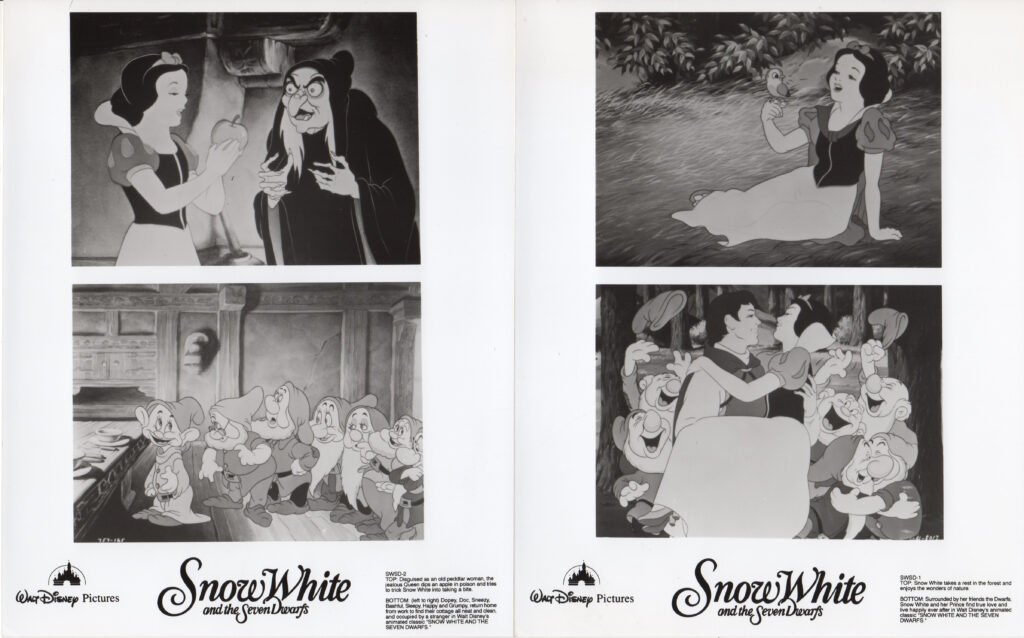
Friendly birds and animals comfort her and come to her aid. They take Snow White to the forest cottage of Seven Dwarfs who are away at work in a nearby diamond mine. Thinking some children might inhabit the house because everything is so tiny, she cleans the house, prepares dinner and then falls asleep. When the Dwarfs — Doc, Happy, Grumpy, Sleepy, Sneezy, Bashful and Dopey — return from work, they find Snow White asleep.
Meanwhile, the Queen consults her magic mirror and discovers the beautiful young princess is, indeed, alive. Disguising herself as an old peddler woman, she dips an apple in poison and the next day, when the Dwarfs are away at work, she visits Snow White at the cottage and tricks her into taking a bite of the apple. She falls to the floor as if dead.
The birds and animals, having recognized the Queen in her disguise, run and fly to the mine to warn the Dwarfs. They return too late to help Snow White, but they pursue the Queen to the top of a cliff where, trapped, she topples to her death.
Heartbroken, the Dwarfs make a glass coffin for their friend because she is too beautiful to bury. Night and day they keep watch over it, thinking all is lost and unaware that the spell of the poisoned apple can be broken by love’s first kiss.
The Prince, who had earlier seen Snow White and fallen in love with her, hears about the coffin and seeks it out. Taken by her beauty, he kisses her. Suddenly, the girl’s eyes open as if awakening from a deep sleep.
Snow White and the Prince ride off together amid the cheers and happy tears of the animals and the seven kindly Dwarfs. And they lived happily ever after.
#
#24986
HEG/fk
6/1/93